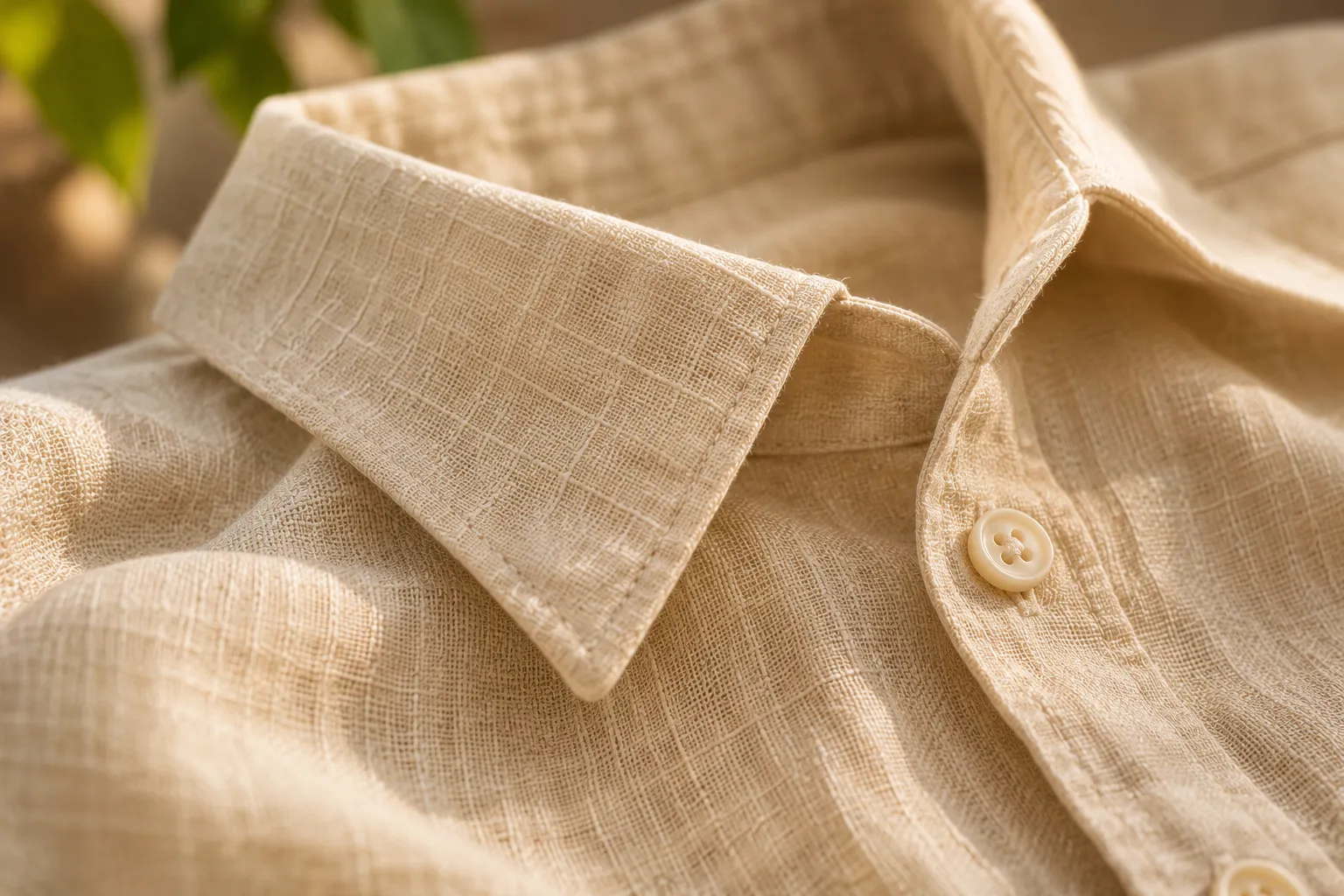
You’re in a shop, or scrolling a product page. The tag says 100% Linen. Feels like enough to go on, right?
It isn’t — not because the label lies, but because it only answers one question. “100% Linen” tells you what the fabric is made of. It tells you almost nothing about how the shirt will feel, hang, breathe, or age. Two shirts can both be 100% linen and be completely different garments.
Here’s what to actually check.
The short answer
“100% Linen” confirms the fibre: it’s all flax, no cotton or polyester blended in. That’s genuinely useful to know. But the qualities you care about in a shirt — the coolness, the drape, the softness, whether you can see through it — come from the weight, the weave, the yarn, and the finish. Check those, and you can tell a good linen shirt from a mediocre one regardless of what the tag boasts.
What “100% Linen” actually tells you
Linen is woven from the fibres of the flax plant (Linum usitatissimum) — one of the oldest textile materials we know of. As a fibre, flax is strong, absorbent, and breathable, and it dries faster than cotton, which is exactly why linen feels good in hot, humid weather.
So “100% Linen” is a real signal. It means:
- The fabric is entirely flax — no hidden synthetic blend.
- You can expect linen’s natural behaviour: breathable, moisture-friendly, quick-drying, and prone to a relaxed wrinkle.
That’s the ceiling of what the composition label promises.
What it does NOT tell you
This is the part most shoppers miss. “100% Linen” is silent on every one of these:
- Fabric weight — a gauzy summer linen and a structured jacket-weight linen can carry the identical tag.
- Weave — how tightly and in what pattern the yarns are interlaced, which drives opacity and drape.
- Yarn fineness — whether the flax was spun into a fine, smooth yarn or a coarse, slubby one.
- Finishing — whether it’s been washed/softened, and how it’ll feel against your skin on day one.
- Construction — stitching and make quality, which no fibre label addresses.
None of these appear in the two words on the tag. You have to check them yourself.
The four things to actually check
1. Weight — feel it, and hold it to the light
Fabric weight is often given as GSM (grams per square metre) — literally how much a square metre of the cloth weighs. Higher GSM is heavier; lower GSM is lighter. But here’s the key: weight is a trade-off, not a quality score.
- Lighter linen — cooler, more breathable, more likely to be slightly sheer. Great for hot-weather shirts.
- Heavier linen — more structure, more opacity, more substantial feel. Better where you want the shirt to hold its shape.
If there’s no GSM listed, hold the fabric up to a light. A lot of light through it means a light, airy (possibly see-through) weave; less light means a denser cloth. Neither is “better” — it depends on what you want the shirt to do.
2. Weave — read it in the light
Weight isn’t the whole story, because weave density and yarn structure also change how opaque and how substantial a fabric feels. A loosely woven light linen drapes softly and breathes freely; a tighter weave feels crisper and more structured. Tilt the fabric to the light and look at how open the weave is. Match it to your use: airy and relaxed, or crisp and sharp.
3. Yarn fineness — the source of “why does this feel nicer?”
Linen yarn fineness is traditionally described by Lea (the linen equivalent of the count systems used for other fibres). A finer yarn generally gives a smoother, softer-feeling cloth; a coarser yarn gives that characteristic rustic, slubby linen texture. One isn’t superior — a fine sheeting linen and a textured rustic linen are just different pleasures. But if two shirts feel very different at the same weight, the yarn is usually why.
4. Finish and feel — trust your hand
Run the fabric between your fingers. Some linen is sold crisp and raw; some is pre-washed or garment-washed to be soft from the first wear. There’s no wrong answer, but know which you’re getting — crisp linen softens with washing over time, so a stiff shirt today may become your favourite in a month.
About the wrinkles
Linen creases. That’s the fibre’s nature — flexing the fabric stresses its structure and it holds the fold. This is not a flaw, and it’s not a sign of cheap linen. If a relaxed, lived-in look isn’t for you, linen may simply not be your fibre — but no amount of money buys a 100% linen shirt that won’t wrinkle.
How to compare two linen shirts
Put two “100% Linen” shirts side by side and you now have a checklist:
- Weight — which suits your climate and use? (Light for heat, heavier for structure.)
- Weave — hold both to the light. How opaque, how open?
- Yarn/feel — which hand-feel do you prefer, smooth or textured?
- Finish — crisp-and-will-soften, or already soft?
- Make — even stitching, secure seams, buttons that feel solid.
The tag is identical. Everything that matters is in your hands.
The honest bottom line
“100% Linen” is a good thing to see — it means you’re getting real flax and its genuine hot-weather comfort. But treat it as the first question, not the last. Weight, weave, yarn and finish are what separate a linen shirt you’ll love from one you’ll leave in the wardrobe. Now you know what to look for.